
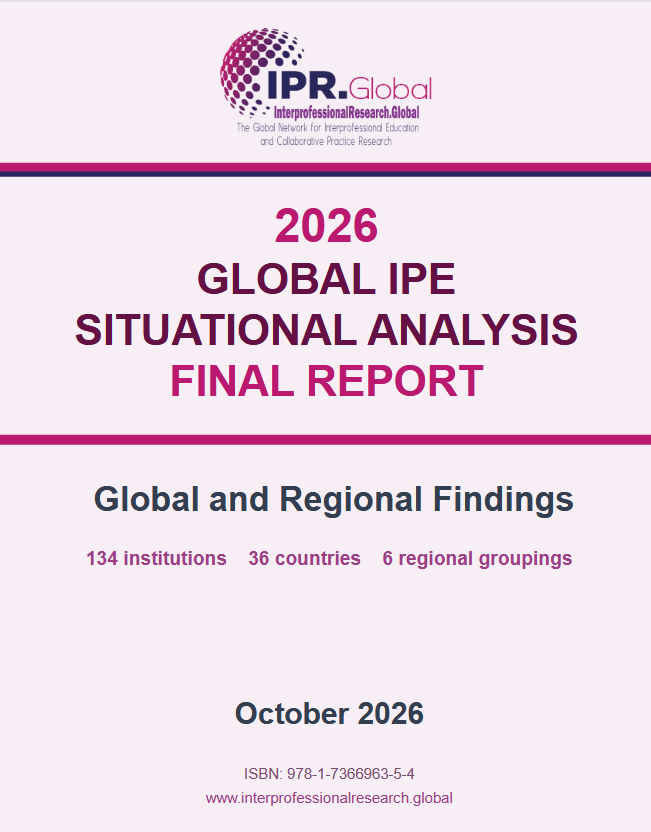
InterprofessionalResearch.Global (IPR.Global) published the 2026 Global IPE Situational Analysis Final Report on October 29, 2026, offering an updated overview of the development, implementation, and sustainability of Interprofessional Education (IPE) across academic institutions worldwide.
Developed under the coordination of Hossein Khalili, the study gathered information from 134 academic institutions across 36 countries, organized into six regional groupings. It examines governance, institutional leadership, funding, curriculum integration, competency frameworks, faculty development, assessment, and research in IPE.
Key Global Findings
The results indicate that 68.9% of institutions responding to the relevant question reported established Interprofessional Education programs, while 15.2% reported initiatives under development.
Nevertheless, challenges related to institutional sustainability remain. Among institutions responding to the respective items, 31.1% reported having no dedicated IPE budget, while 21.8% had no formal leadership role for interprofessional education.
Faculty development also emerged as an important area: 57.5% of institutions responding to the relevant item reported providing professional development opportunities for educators and other staff involved in IPE.
The findings suggest that a major challenge is moving beyond isolated initiatives toward the institutionalization of interprofessional education through policies, governance structures, sustainable resources, and evaluation mechanisms.
Latin American Participation
The study included 18 academic institutions from six Latin American countries, representing 13.4% of the 134 participating institutions.
Their distribution was as follows:
- Brazil: 10 institutions.
- Colombia: 4 institutions.
- Chile: 1 institution.
- Honduras: 1 institution.
- Peru: 1 institution.
- Uruguay: 1 institution.
Although the report uses the regional designation “South America and Mexico,” its list of participating countries includes Honduras and records no institutional responses from Mexico or Caribbean countries.
This distribution highlights the importance of expanding participation from Latin America and the Caribbean in future international research.
Implications for Interprofessional Education and Collaborative Practice in the Region
Within the report’s regional analytical grouping, the main challenges include curriculum integration, facilitator preparation, institutional recognition, funding, and research continuity.
These findings provide valuable insights for strengthening educational policies, sustaining IPE initiatives, and connecting interprofessional learning with collaborative practice in healthcare services.
For the REIP, the report provides an opportunity to promote regional dialogue, share experiences, and strengthen cooperation among educational institutions, researchers, healthcare professionals, and national networks.
The findings should be interpreted with caution, as the study did not use a global probability-based sampling approach and therefore does not provide statistically representative estimates for all institutions or countries.
Source: Khalili, H. (2026). 2026 Global IPE Situational Analysis Final Report. InterprofessionalResearch.Global. ISBN: 978-1-7366963-5-4. Published October 29, 2026.